
The Constitution of India is a living document that has evolved with the changing needs of Indian society, politics and governance. Since its adoption on 26 November 1949, the Constitution has been amended several times to address emerging challenges, strengthen democracy and introduce important social, economic and political reforms.
The major constitutional amendments in India have changed everything from Fundamental Rights and Centre-State relations to local self-government, reservations, taxation and women’s representation.
What Is a Constitutional Amendment in India?
A constitutional amendment refers to a formal change, addition or deletion made to the provisions of the Constitution. The primary provision dealing with constitutional amendments is Article 368.
The Constitution-makers deliberately made the Constitution neither completely rigid nor completely flexible. Some provisions can be changed through a simple majority in Parliament, while others require a special majority and, in certain cases, ratification by at least half of the state legislatures.
This system allows the Constitution to adapt while protecting its fundamental principles.
How Are Constitutional Amendments Made in India?
The procedure for constitutional amendment depends on the provision being amended.
There are broadly three methods:
- Simple Majority: Certain provisions can be amended by a simple majority of Parliament.
- Special Majority: Most constitutional provisions require a majority of the total membership of each House and a two-thirds majority of members present and voting.
- Special Majority + State Ratification: Amendments affecting important federal provisions also require ratification by at least half of the state legislatures.
A Constitutional Amendment Bill can be introduced in either House of Parliament. Unlike an ordinary bill, there is no provision for a joint sitting if the two Houses disagree.
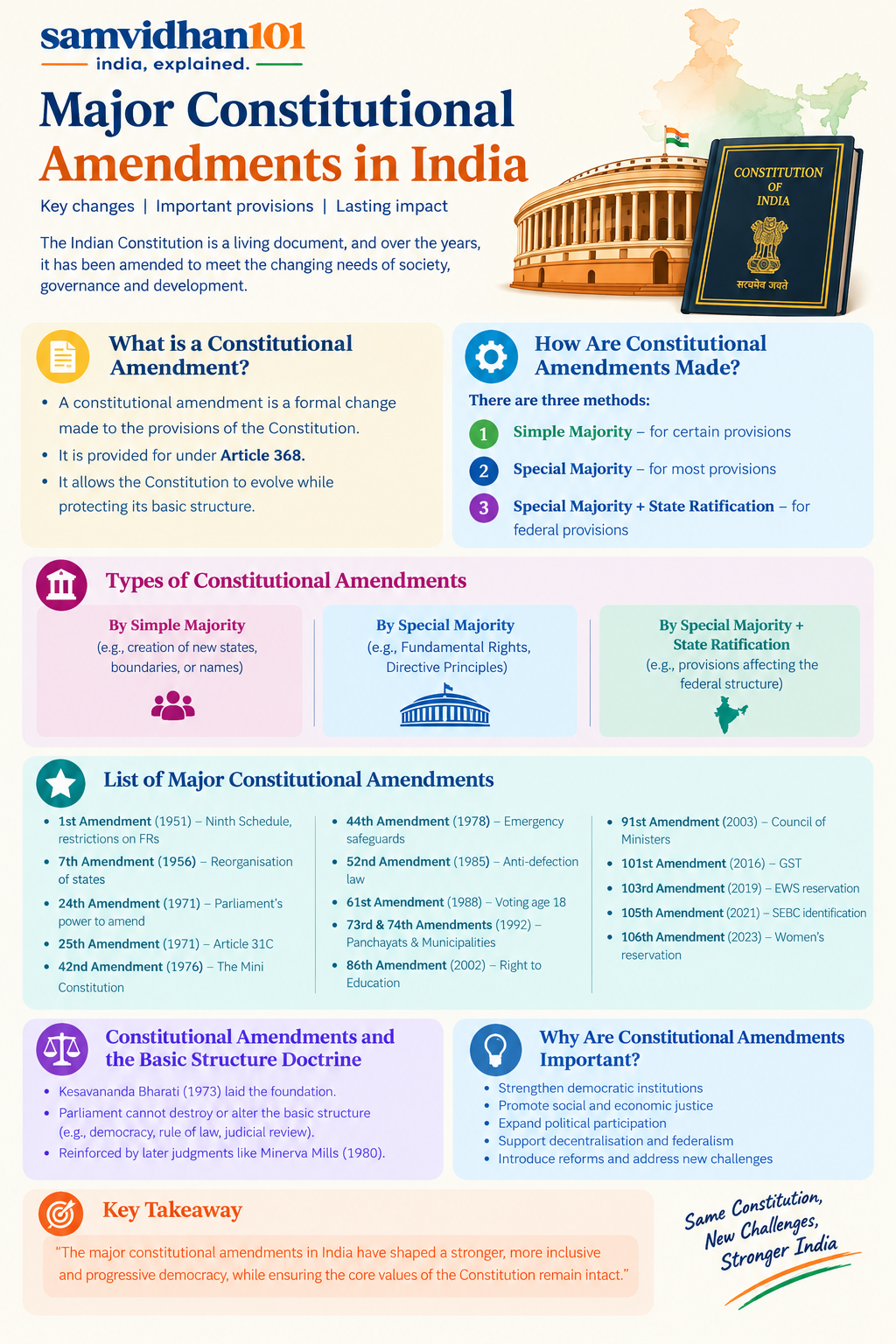
List of Major Constitutional Amendments in India
The following are some of the most important constitutional amendments for students, UPSC aspirants and anyone studying Indian polity:
Amendment | Year | Major Provision |
1st Amendment | 1951 | Added Articles 31A, 31B and the Ninth Schedule; introduced restrictions on certain Fundamental Rights |
7th Amendment | 1956 | Reorganised states and abolished the earlier classification of states |
24th Amendment | 1971 | Confirmed Parliament’s power to amend the Constitution, including Fundamental Rights |
25th Amendment | 1971 | Introduced Article 31C and strengthened certain Directive Principles |
42nd Amendment | 1976 | Known as the Mini Constitution; made extensive changes to the Constitution |
44th Amendment | 1978 | Reversed several Emergency-era changes and strengthened safeguards for Fundamental Rights |
52nd Amendment | 1985 | Introduced the Anti-Defection Law through the Tenth Schedule |
61st Amendment | 1988 | Reduced the voting age from 21 to 18 years |
73rd Amendment | 1992 | Gave constitutional status to Panchayati Raj institutions |
74th Amendment | 1992 | Gave constitutional status to urban local bodies |
86th Amendment | 2002 | Introduced Article 21A and made education a Fundamental Right for children aged 6–14 |
91st Amendment | 2003 | Limited the size of the Council of Ministers and strengthened anti-defection provisions |
101st Amendment | 2016 | Introduced the constitutional framework for GST |
103rd Amendment | 2019 | Introduced up to 10% reservation for Economically Weaker Sections |
105th Amendment | 2021 | Restored states’ power to identify socially and educationally backward classes |
106th Amendment | 2023 | Provided for one-third reservation for women in the Lok Sabha and State Legislative Assemblies |
42nd Constitutional Amendment Act, 1976 — The Mini Constitution
The 42nd Constitutional Amendment Act, 1976 is one of the most significant amendments in Indian constitutional history and is popularly known as the Mini Constitution.
It made extensive changes during the Emergency period. Among its major changes were the addition of the words “Socialist,” “Secular” and “Integrity” to the Preamble and the introduction of Fundamental Duties.
It also attempted to strengthen the role of the Directive Principles of State Policy and made several changes relating to Parliament, the judiciary and Centre-State relations.
Because of its far-reaching impact, the 42nd Amendment remains one of the most important topics in Indian polity.
44th Constitutional Amendment Act, 1978
The 44th Amendment was enacted after the Emergency to reverse several controversial provisions introduced during the previous period.
One of its important changes was replacing the phrase “internal disturbance” with “armed rebellion” as a ground for declaring a National Emergency.
It also provided greater protection to Articles 20 and 21 during an Emergency and changed the constitutional status of the Right to Property. The Right to Property ceased to be a Fundamental Right and became a constitutional legal right under Article 300A.
73rd and 74th Constitutional Amendments
The 73rd and 74th Amendments, enacted in 1992, transformed grassroots democracy in India.
The 73rd Amendment gave constitutional status to Panchayati Raj institutions and added Part IX and the Eleventh Schedule to the Constitution.
The 74th Amendment dealt with urban local governments. It introduced Part IX-A and the Twelfth Schedule, providing a constitutional framework for municipalities.
Together, these amendments strengthened decentralisation and increased people’s participation in local governance.
101st Constitutional Amendment Act, 2016 — GST
The 101st Constitutional Amendment Act created the constitutional framework for the Goods and Services Tax (GST).
GST replaced several indirect taxes with a more integrated taxation system. The amendment also established the GST Council, an important institution representing both the Union and the states.
The amendment is particularly significant for understanding fiscal federalism in India.
103rd Constitutional Amendment Act, 2019 — EWS Reservation
The 103rd Amendment introduced constitutional provisions for reservation for Economically Weaker Sections (EWS).
It inserted Articles 15(6) and 16(6), enabling up to 10% reservation for economically weaker sections in educational institutions and public employment, subject to constitutional conditions.
This amendment is important in discussions concerning equality, affirmative action and reservation policy.
106th Constitutional Amendment Act, 2023 — Women’s Reservation
The 106th Constitutional Amendment Act, 2023, popularly associated with the Nari Shakti Vandan Adhiniyam, introduced provisions for reserving approximately one-third of seats for women in the Lok Sabha and State Legislative Assemblies, including the Delhi Legislative Assembly.
Its implementation is linked to delimitation and the constitutional process specified by the amendment, making it an important contemporary constitutional development.
Constitutional Amendments and the Basic Structure Doctrine
Parliament’s power to amend the Constitution is not unlimited.
In the landmark Kesavananda Bharati v. State of Kerala (1973) judgment, the Supreme Court established the Basic Structure Doctrine. According to this doctrine, Parliament can amend the Constitution but cannot destroy or alter its basic structure.
Features such as constitutional supremacy, rule of law, judicial review, separation of powers and the basic character of democracy have been recognised as part of the constitutional framework protected by this doctrine.
Later cases, including Minerva Mills v. Union of India, further reinforced limitations on Parliament’s amending power.
Why Are Constitutional Amendments Important?
Constitutional amendments allow India’s constitutional system to respond to changing circumstances.
They have helped:
- Strengthen democratic institutions
- Promote social and economic justice
- Expand political participation
- Establish local self-government
- Reform taxation
- Introduce reservation policies
- Protect constitutional rights
- Improve Centre-State relations
- Address emerging social and political challenges
Therefore, studying amendments chronologically as well as thematically provides a better understanding of how the Indian Constitution has evolved.
Major Constitutional Amendments in India: Key Takeaways
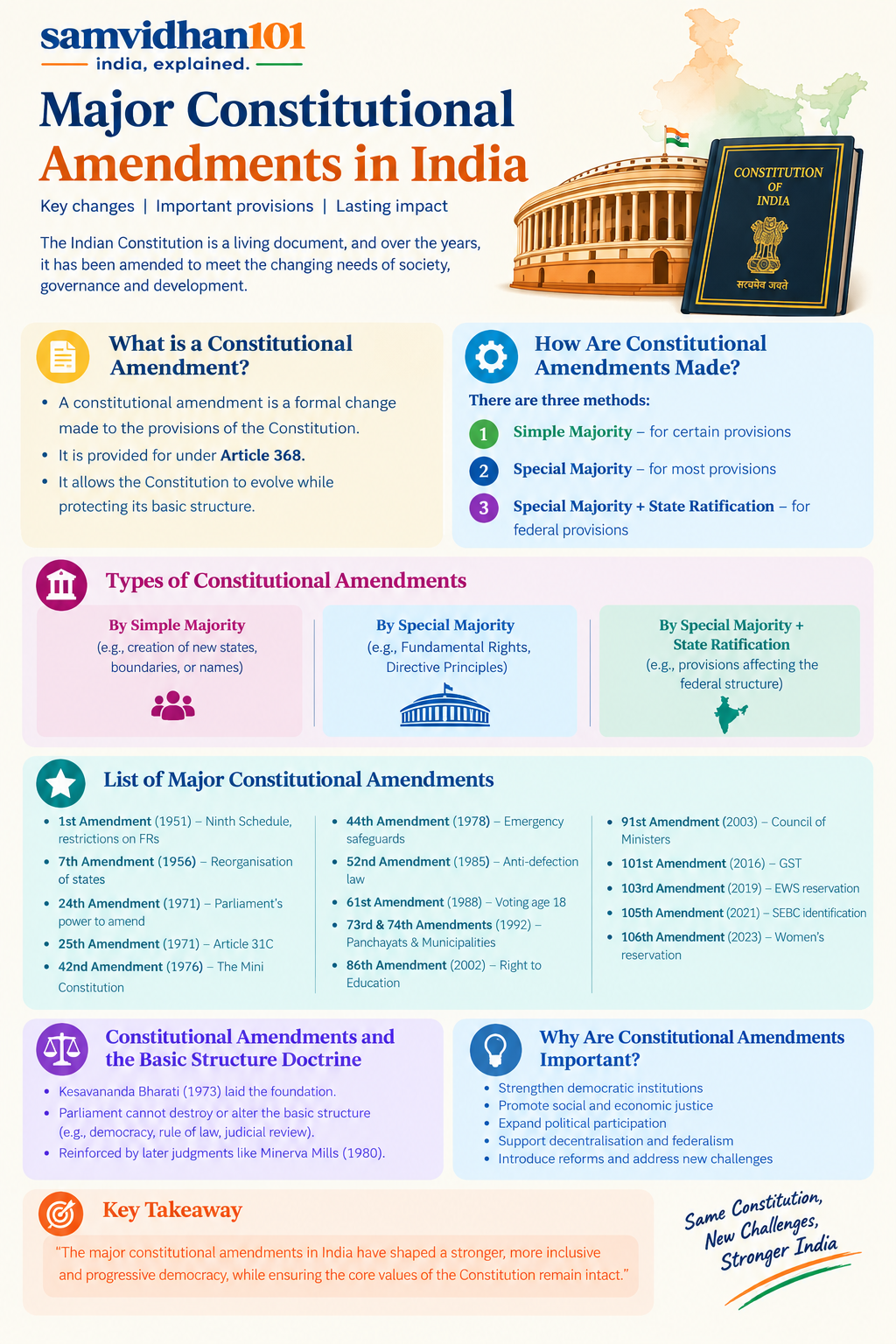
For quick revision, remember these landmark amendments:
- 1st Amendment, 1951 — Ninth Schedule and restrictions on Fundamental Rights
- 42nd Amendment, 1976 — Mini Constitution
- 44th Amendment, 1978 — Emergency safeguards
- 52nd Amendment, 1985 — Anti-Defection Law
- 61st Amendment, 1988 — Voting age reduced to 18
- 73rd Amendment, 1992 — Panchayats
- 74th Amendment, 1992 — Municipalities
- 86th Amendment, 2002 — Right to Education
- 101st Amendment, 2016 — GST
- 103rd Amendment, 2019 — EWS reservation
- 105th Amendment, 2021 — States’ power concerning SEBC identification
- 106th Amendment, 2023 — Women’s reservation