
The Kashmir issue is one of the most complex and long-standing disputes in South Asia. It began during the Partition of British India in 1947 and has since shaped relations between India and Pakistan. The dispute has involved wars, military standoffs, terrorism, diplomatic negotiations and major constitutional changes.
The broader Kashmir region is also connected with China because of its control over Aksai Chin. Over the decades, several conflicts—from the first Kashmir War and the Kargil War to the Siachen conflict, Surgical Strikes, the Balakot Airstrike and Operation Sindoor—have influenced the security environment around Kashmir.
What is the Kashmir Issue?
The Kashmir issue concerns competing territorial and political claims over the former princely state of Jammu and Kashmir.
India’s position is based on the Instrument of Accession signed by Maharaja Hari Singh in 1947, through which Jammu and Kashmir acceded to India. Pakistan disputes India’s position and has historically argued for the right of Kashmiris to determine the region’s political future.
The dispute therefore has several dimensions, including territory, sovereignty, security, terrorism, political aspirations and India-Pakistan relations.
Kashmir Issue: Historical Background
Before independence, Jammu and Kashmir was a princely state ruled by Maharaja Hari Singh. When British rule ended in 1947, princely states had to decide their future relationship with India or Pakistan.
Maharaja Hari Singh initially attempted to remain independent. However, the situation changed when tribal forces entered Jammu and Kashmir in October 1947.
Seeking military assistance from India, Maharaja Hari Singh signed the Instrument of Accession. India accepted the accession and sent troops to the region.
This led to the First India-Pakistan War of 1947–48 and established the foundation of the modern Kashmir dispute.
Major Wars and Conflicts Related to the Kashmir Issue
Kashmir has been associated with several major wars and military confrontations between India and Pakistan.
Conflict | Year | Main Issue/Trigger | Outcome |
First Kashmir War | 1947–48 | Accession and tribal invasion | Ceasefire and territorial division |
India-Pakistan War | 1965 | Kashmir and military confrontation | Ceasefire |
India-Pakistan War | 1971 | Bangladesh Liberation War | Creation of Bangladesh; later Simla Agreement |
Siachen Conflict | 1984–2003 | Control of Siachen Glacier | India retained key positions |
Kargil War | 1999 | Pakistani intrusion across LoC | India regained most occupied positions |
Military Standoff | 2001–02 | Parliament attack and heightened tensions | De-escalation through diplomacy |
Surgical Strikes | 2016 | Uri terror attack | India announced strikes on terror launch pads |
Balakot Airstrike | 2019 | Pulwama terror attack | IAF strike in Pakistan |
Operation Sindoor | 2025 | Pahalgam terror attack | Indian military retaliation followed by ceasefire |
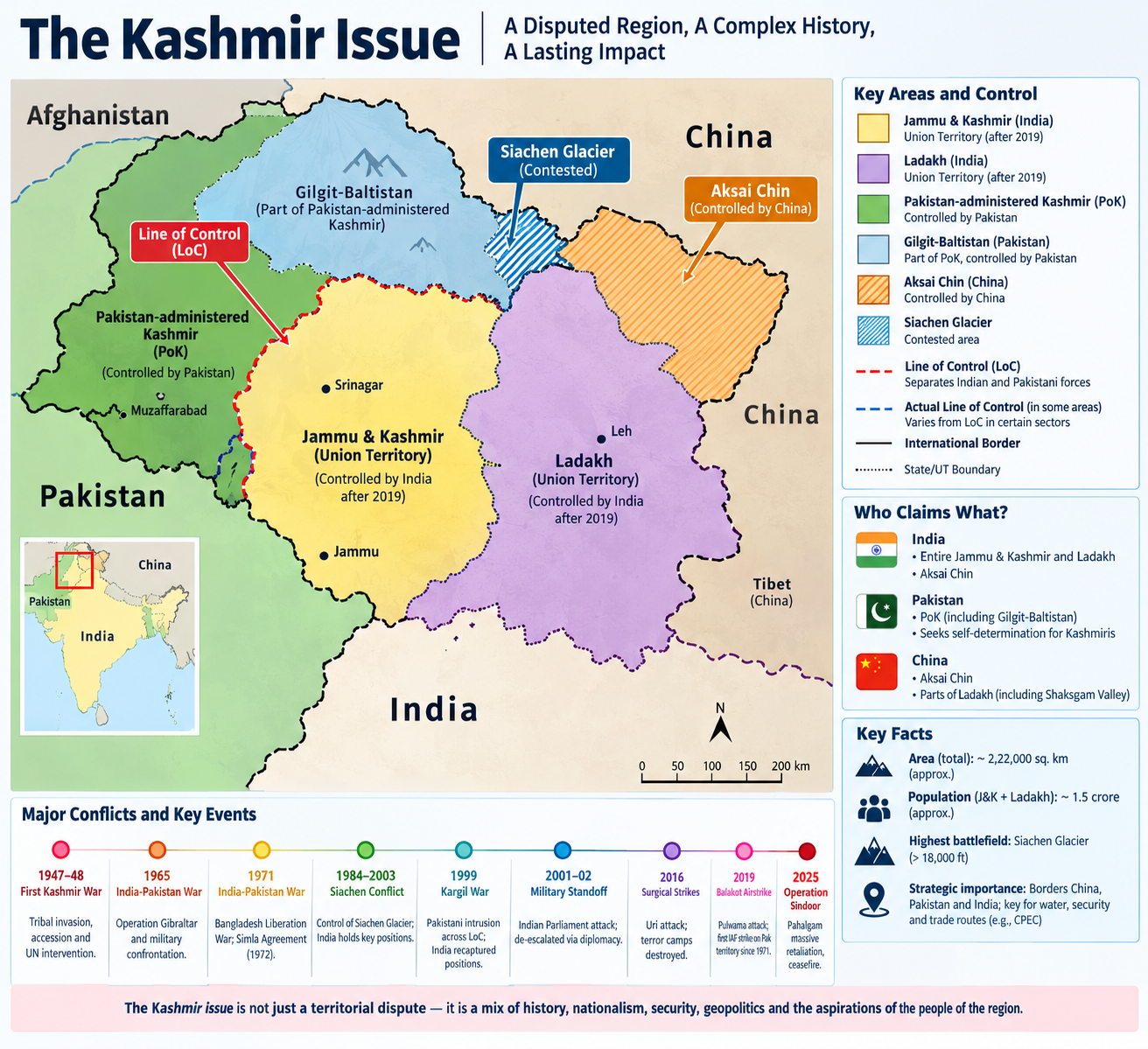
First Kashmir War (1947–48)
The first war began shortly after the accession of Jammu and Kashmir to India. Fighting continued between Indian forces and forces supported by Pakistan.
The conflict ended with a UN-backed ceasefire, leaving the territory divided between the two sides.
1965 India-Pakistan War
The 1965 war was strongly connected to Kashmir. Pakistan launched Operation Gibraltar, involving infiltration into Jammu and Kashmir, while India responded militarily.
The conflict eventually ended after international diplomatic intervention and a ceasefire.
1971 India-Pakistan War
The 1971 war was primarily associated with the Bangladesh Liberation War rather than Kashmir. India and Pakistan fought on multiple fronts, and the conflict resulted in the creation of Bangladesh.
The Simla Agreement of 1972 subsequently established the Line of Control in place of the earlier ceasefire line and emphasised bilateral resolution of outstanding issues.
Siachen Conflict (1984–2003)
The Siachen Conflict was fought over control of the strategically important Siachen Glacier in the eastern Karakoram.
In 1984, India launched Operation Meghdoot and secured key positions around the glacier.
The extremely high-altitude battlefield became one of the world’s most challenging military environments. India retained strategically important positions, while both sides suffered casualties primarily due to extreme weather and terrain.
Active hostilities gradually declined, although the broader territorial disagreement continued.
Kargil War (1999)
The Kargil War began after Pakistani forces and infiltrators occupied strategic positions on India’s side of the Line of Control.
Indian forces launched operations to recapture the positions. After intense fighting and international diplomatic pressure, Pakistani forces withdrew.
The Kargil conflict demonstrated the continuing military risks surrounding the Kashmir dispute, even after India and Pakistan became nuclear-armed states.
India-Pakistan Military Standoff (2001–02)
Following the terrorist attack on the Indian Parliament in December 2001, India and Pakistan entered a major military standoff.
Large numbers of troops were mobilised along the international border and Line of Control. Diplomatic efforts and international pressure eventually helped prevent the confrontation from escalating into a full-scale war.
Surgical Strikes (2016)
After the Uri terror attack in September 2016, India announced that its armed forces had conducted surgical strikes across the Line of Control against alleged terrorist launch pads.
The strikes marked a significant change in India’s publicly stated military response to cross-border terrorism and became an important development in India-Pakistan relations.
Balakot Airstrike (2019)
Following the Pulwama terror attack in February 2019, India conducted an airstrike at Balakot in Pakistan.
India stated that the operation targeted a Jaish-e-Mohammed training camp. Pakistan disputed India’s claims regarding the scale and impact of the strike.
The Balakot operation was significant because it represented an Indian Air Force strike beyond the immediate Line of Control and was widely seen as a major escalation in India-Pakistan tensions since 1971.
Operation Sindoor (2025)
Operation Sindoor became a major development in the Kashmir-related security environment following the Pahalgam terror attack in April 2025.
India announced military strikes against terrorist infrastructure, describing the operation as a punitive response to the attack.
The subsequent military confrontation involved missile, drone and other military activity between India and Pakistan before a ceasefire was announced.
Operation Sindoor further demonstrated how a major terrorist attack in or connected with Jammu and Kashmir could rapidly escalate into a broader India-Pakistan military confrontation.
Kashmir Insurgency and Terrorism
From the late 1980s, Jammu and Kashmir experienced a major insurgency involving militant groups, terrorism, political instability and counter-insurgency operations.
Cross-border infiltration and support for militant groups became major issues in India-Pakistan relations.
The insurgency also had severe consequences for civilians. The Kashmiri Pandit exodus during the early 1990s resulted in the displacement of a large number of members of the community from the Kashmir Valley.
China's Role in the Kashmir Issue
China is another important factor in the Kashmir dispute.
China controls Aksai Chin, which India claims as part of Ladakh. The region has strategic importance because of its geographical connection with China’s Xinjiang and Tibet regions.
China’s relationship with Pakistan also adds another dimension to the dispute. The China-Pakistan Economic Corridor (CPEC) passes through areas claimed by India.
Therefore, the Kashmir issue is not simply a bilateral India-Pakistan dispute; it also has wider geopolitical implications.
India's Position on the Kashmir Issue
India maintains that Jammu and Kashmir legally became part of India through the Instrument of Accession signed in 1947.
India considers Jammu and Kashmir and Ladakh integral parts of the country and has consistently raised concerns regarding cross-border terrorism.
India has also maintained that outstanding bilateral issues with Pakistan should be addressed through peaceful and bilateral mechanisms.
Pakistan's Position on the Kashmir Issue
Pakistan considers Kashmir a disputed territory and has historically argued that the Kashmiri people should have a role in determining the region’s political future.
Pakistan frequently refers to the UN resolutions concerning Kashmir and continues to raise the issue in international forums.
These fundamentally different positions have made a final political settlement difficult.
Why Has the Kashmir Issue Remained Unresolved?
Several factors have contributed to the continuing Kashmir issue:
- Competing territorial claims
- Different interpretations of the 1947 accession
- India-Pakistan wars and military tensions
- Cross-border terrorism and militancy
- Political aspirations within Jammu and Kashmir
- India’s constitutional changes after 2019
- China’s territorial involvement
- Disagreements over the role of the United Nations
- Lack of sustained India-Pakistan dialogue
The dispute has therefore developed far beyond a simple territorial disagreement.
Way Forward on the Kashmir Issue
A lasting solution to the Kashmir issue requires reducing violence, protecting civilians, strengthening democratic institutions and improving economic opportunities.
India and Pakistan would need sustained diplomatic engagement to address bilateral concerns, while stability within Jammu and Kashmir would depend on effective governance, development and political participation.
The history of Kashmir shows that military confrontations alone have not permanently resolved the dispute. Long-term peace requires political, diplomatic and security measures working together.